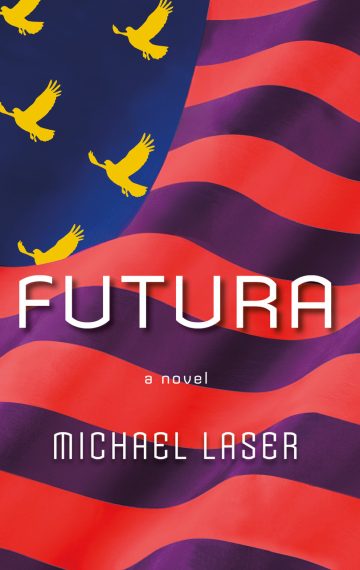
The year is 2045.
An authoritarian president is starting his third term. Protests are severely restricted. Privacy is no longer a right.
The teenagers in a New Jersey shore town skirt the new laws recklessly— but their freedom is in jeopardy.
Charming Cardo supports himself and his ailing father by selling an illegal app.
Conservative Midwestern transplant Bob falls in love, inconveniently, with Danai—an undocumented immigrant from Africa who lives under the constant threat of deportation.
Elora, a rebellious artist, attracts a cop’s unwanted interest, with disastrous results.
More recognizable than the dystopia of Orwell’s 1984, Michael Laser’s Futura takes aim at the present by envisioning a future that’s just a little darker—balancing its dread with comedy and moments of surprising heroism.
———————-
“Laser takes time to bring real pathos to his characters… The result is a narrative that is both engaging and memorable. A deeply felt novel whose characters will feel familiar and fresh all at once.” — Kirkus Reviews
“Futura is the contemporary dystopian novel that is second only to George Orwell’s iconic dystopian novel 1984… A fascinating and compelling read from start to finish, Futura is especially and unreservedly recommended…” — Midwest Book Review
COMMENTS:
After January 6th, 2021, I didn’t think that Donald Trump or anyone like him would get near the White House for a long time. But I assumed that, sooner or later, people would forget.
To put off that day, I started work on a novel about what America might look like if extreme conservatives got their way—if they managed to tick off every box on their wish list. I wanted the book to serve as a warning, a 1984 for our time.
But every dystopia needs characters who suffer within it. So I invented four teenagers, each with a different problem caused in part by the new realities. These aren’t political kids. They just want to live their lives. But some big roadblocks are standing in their way:
I thought I had all the time in the world to write this book. By the time I finished, though, Trump was running for president again. And by the time my agent sent it out, the 2024 election was over.
Suddenly my warning for the future seemed moot—a few weeks too late.
Then a few months passed, and the new administration began fulfilling the promises of Project 2025. When I looked at the book again, I saw that some of the ugly doings I predicted had already come true: most dramatically, the relentless hunt for undocumented immigrants. But much of what I warned about hasn’t happened yet. It seems to me that the book isn’t too late after all. The message is still relevant.
One last comment. Even though the inspiration for the book was political, once I started writing it, the characters and their problems became more interesting to me than the politics. (They have crushes on each other, often unrequited; they have complicated friendships; and they have to deal with crappy after-school jobs and mediocre teachers.) It’s really the story of four very specific kids, and how they navigate these complicated times.
EXCERPT:
“Who’s going to enlighten us as to why the southern states seceded?” Mr. Cangialosi asked. “Amethyst, how about you?”
At the front of the room, a map glistened on the screen. It showed the Union states in bright blue; those that seceded were blood red; the “border” states were yellow; and the western territories were gray.
Amethyst hadn’t watched a homework clip all year. She stared at the screen like a mannequin, while other students played games on their wrists and messaged friends. Mr. C drew figure eights on the ceiling with the red dot of his pointer. In just a few weeks, his thirty-year stretch would be up; he could already taste freedom.
An anonymous fart was followed by the teacher’s standard response: “That was very ass-toot of you.”
Not a peep from Amethyst. “Fabio, give it a try,” Mr. C said.
“They wanted to do things the way they wanted? Instead of taking orders from a central government in Washington?”
“The textbook says you’re right. Congratulations.”
“That’s bullshit and everyone knows it,” Kristi said.
“You’ll have to take that up with your congressperson,” the teacher said, and winked, unless that was his tic, which came and went unpredictably.
“Are you scared to say the S word, Mr. C?” Aracelis asked.
Unperturbed, he aimed the pointer at the golden eagle on top of the flag staff. “You want me to risk my pension for a meaningless gesture? Sorry. But if you or Kristi want to express a subversive opinion, go right ahead.”
Kristi dove in. She said that the southern states assumed it was only a matter of time before Lincoln outlawed slavery, so a few weeks after he took office, they broke away.
Mr. C asked where she’d picked up this information. She said, “It’s out there if you look for it. And you should be teaching it.”
“Check in with me in twenty years. We’ll see if you’re still fearless.”
Those who were listening laughed. But one student thrust his hand straight in the air.
“Yes, Mr. Babic? Let’s hear your take on this.”
“It’s pronounced Babitch,” Bob reminded the teacher, in unison with the twins, Oliver and Fuzzy, who mimicked him this way every time. Ignoring them, Bob said, “There’s a reason why teachers aren’t supposed to talk about slavery.”
Once again, Bob explained the need to heal the fractures in American society: how dividing people by race, religion, and country of family origin had only made everyone angry at their neighbors. How President DePinto wanted to raise a new generation, not poisoned by harmful ideas. “Look around,” Bob said. “See all the different shades of skin color? That’s what’s beautiful about America. But we have to get past the resentments. Like the president says, you can’t move forward if your wheels are stuck in the mud.”
Fuzzy said, “Go, B’bitch, go!”
“M-m-moron, you mean.” That was Draymond Quincey, who never smiled.
Mr. C rapped on his desk twice, his shorthand for unacceptable. But the insult hadn’t hurt Bob much. Like an injection, it was easy enough to endure, and worth the sting, since the alternative—keeping his opinion to himself—would have made him a coward.
Bob’s family had moved to this shore town three years earlier. He knew what people thought of him. To them, he was a hick from the middle of America, where people still naively believed in things like patriotism, loyalty, courtesy, and courage. Partly because of the straight part in his short hair, some people called him Scouty McScout—which had gotten under his skin at first, because in fact he had wanted to be an Eagle Scout, and would have achieved that rank if the last troop in town hadn’t disbanded before he arrived.
But Bob knew something his classmates didn’t. They were the naive ones. They had never questioned the whole package of opinions that most people around here seemed to share. This presented him with two options: he could keep quiet and spare himself the mockery, or he could speak up and defend his ideas. Even if no one agreed publicly, they might think things over when they were alone. Someday they might change their minds.
His mother had taught him to hate no one and meet the world with goodwill; his father had taught him never to doubt what he knew was true. Therefore, he dissented regularly, but he did it in a congenial way. When they teased him, he took it as friendly kidding. At least he tried to.
Kristi never mocked Bob, but she argued against everything he said, always. “There’s a new law against boys wearing makeup,” she told him. “Did you know that? The president talks a lot about freedom, but he keeps taking more of it away.”
“Fucking ridiculous,” Aracelis said.
“I say people should ignore the new laws. They can’t arrest everyone.”
“Nope,” Bob said. “You’re free to protest, but not to break the law. If you don’t like it, change it.”
Eyes rolled. Aracelis raised her hand and said, “Could we go back to slavery?” She listed some of the abuses slaves had been subjected to. Rape. Branding. Salt on whip-wounds. Amputation of limbs. Castration.
Oliver and Fuzzy moaned.
Bob had never heard of these particular punishments and doubted they were all factual. He didn’t know how to respond.
Kristi challenged him again. “Do you really think it’s better not to learn these things?”
He made the best case he could. “I don’t necessarily believe those things really happened. I’d have to look into it. But even if they did, how does dwelling on it help? That was two hundred years ago. It just stirs up old grudges.”
Aracelis slapped her desk. “I can’t believe you really mean the things you say.”
She was questioning his sincerity, and that called for a firm response. “I think there are people in this room who agree with me, but they don’t want to say so because they’ll get attacked.”
“I don’t think so, Bob,” Oliver said. “Nobody agrees with you. But we like your spunk.”
“I like your shirts,” Fuzzy said. “And your pen.”
That was sarcasm, since Bob always wore button-down shirts in checked patterns while Fuzzy preferred iridescent T-shirts; also, Fuzzy said, “Nice pen, Bob,” about three times a week, referring to the ballpoint he kept in his shirt pocket.
The debate went on, and Mr. C let it, because it freed him to read the news on his wrist. Draymond brought up the highways, which were starting to fall apart. “They shouldn’t have privatized the maintenance,” he said. “And now you have to pay on the interstates. And that’s the president’s brother’s company! No corruption there.”
Bob started to say that you have to expect a few fumbles when you make revolutionary changes, but the lockdown siren interrupted him. The bolts shot, securing the door, and the steel panel slid across the little window.
Everyone got up and crowded behind the security barrier. They took their time, though. Pranksters set off the system a few times a year by lighting small explosives in the hall. So far, Ocean Park High had never had a shooting.
“Whoever had tuna for lunch, get away from me.”
“Whoever’s wearing that perfume, mm-mm-mm.”
They didn’t have to hide for long. The custodian found the cardboard casing that had held the little bomb, and she unlocked all the doors from her office. The students were already back at their desks when the principal said over the PA, “You may return to your seats.”
Mr. C asked, “Where were we?”
Kristi turned in her chair and looked Bob straight in the eye. “DePinto’s policies hurt so many people. Why doesn’t that matter to you?”
“That’s not fair. He’s trying to solve problems everyone else just ignored.”
“Fools like you are the reason why he’s president,” Aracelis said.
A few students whooped. Someone played a blast on a vuvuzela app.
“I’ll take that as a compliment,” Bob said. Back home, he reminded himself, at least half the people in the room would have agreed with him. “And you should be more respectful when you talk about him.”
Draymond let out a strangled arghhh. Bob grinned, as if to say that their taunts amused him. It was a false grin, though. He tried to shut it off but found that he couldn’t.
A few desks away, Danai Kunaka turned her head. She had been murmuring notes into her Swiss; now her eyes met his. Her smile was merciful and sympathetic.
Danai came from Zimbabwe. She was the only other person in the room with glasses. Hers had simple black octagonal frames: the old kind, without any tech. She didn’t wear makeup or jewelry, except for her wooden bead necklace, with a little carved grasshopper at the bottom. Darker than most black Americans, she had a roundish face and only the faintest trace of an accent.
He had never thought much about her, but starting at that moment, he thought about her a lot. She was always polite, always pleasant. She rarely raised her hand, but seemed to know the answer anytime a teacher called on her. Like him, she had grown up far away. Maybe she agreed with him. Maybe she respected his opinions, and the courage it took to express them.
She went back to dictating her notes. Her hair, in thin braids, just reached her shoulders.
His mother had once told him, Sometimes, when you’re knocked down, that’s when the seed of your salvation is planted. She meant it in the religious way, but right now he took the words as a more worldly encouragement.
“The president is literally shredding the Constitution,” Kristi said. “If we don’t get more people into the streets, we’ll end up with total totalitarianism!”
Bob could see words spilling across Danai’s screen as she whispered to her wrist, but he couldn’t see what they said. He wondered: were they about him?